 Water Removal Colorado Springs
 Mold Remediation in Colorado Springs: Companies, Process & Costs
Last updated: September 2026
Price ranges are compiled from national cost guides and published local pricing as of September 2026; details on the mold remediation cost page.
What Mold Remediation Actually Includes
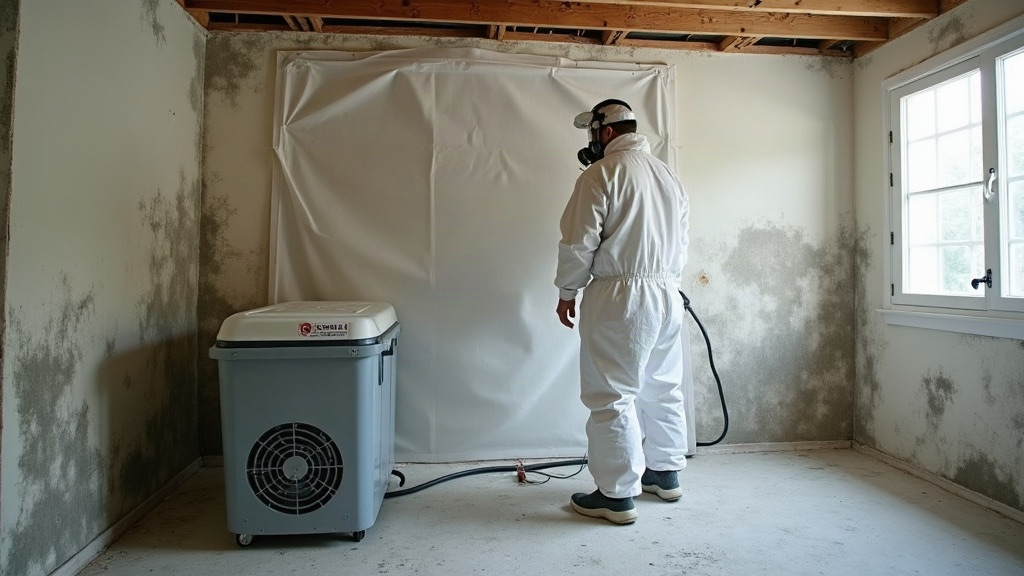
Real remediation is a controlled demolition and cleaning process, not a spray-and-go. A professional job runs in sequence: assessment (moisture mapping, sometimes third-party testing), containment (plastic barriers and negative air pressure so spores don't migrate), removal (moldy drywall, insulation and carpet pad are bagged and discarded — porous materials are not "cleaned"), HEPA filtration and cleaning of remaining surfaces, antimicrobial treatment, and finally drying verification with moisture readings.
The step that separates professionals from handymen is containment. Disturbing mold without negative-pressure containment aerosolizes spores through the whole house — including into the HVAC system, which then distributes them to every room. If a contractor proposes to "just cut it out" without barriers and air scrubbers, that's not remediation.
Mold in a Dry Climate: The Colorado Springs Version
Colorado Springs averages low humidity, and that genuinely helps — surfaces dry fast here, and a quickly dried clean-water loss often never grows mold. The local mold pattern is almost always hidden moisture: a slow supply-line leak inside a wall, a roof leak from a hail-damaged valley that drips into an attic for a season, a basement wall that wicks snowmelt through the spring, or a swamp cooler line with a pinhole leak.
That's why "I don't see mold" settles nothing. The giveaway signs are a musty odor, baseboards swelling or pulling away, paint bubbling, and staining that grows between rains. Colorado's freeze-thaw cycle adds a twist: pipes that crack in a January freeze may leak slowly inside walls for weeks before the stain appears. Our water damage guide covers the early signs in walls in detail.
When You Need a Professional — and When You Don't
The widely used EPA guideline: areas under roughly 10 square feet on hard, non-porous surfaces are reasonable DIY with detergent, protective gloves and a mask. Call a professional when the affected area is larger, when mold is on drywall, insulation or carpet, when it's in the HVAC system, when it follows a sewage or contaminated-water event, or when anyone in the home has respiratory conditions that mold aggravates.
One more rule: remediation without fixing the moisture source is a subscription, not a solution. Any quote that doesn't start with "here's where the water is coming from and here's how we stop it" is incomplete. If the source is an active leak, our emergency water removal page is the faster starting point.
Who Does Mold Remediation in Colorado Springs
Most full-service restoration companies in the metro run mold remediation as a core service — SERVPRO of Central Colorado Springs, United Water Restoration Group, 1-800 WATER DAMAGE, PuroClean and Paul Davis all list mold work, as do local independents like CMS Restoration and RARE Restoration. Details and published phone numbers are on our companies page and the top-picks comparison.
Colorado does not license mold remediators as a trade, so vet on process instead: IICRC-certified technicians, written containment plans, and post-remediation verification. For larger or health-sensitive jobs, consider an independent third-party mold assessor who tests before and after but does not sell the remediation — the separation keeps everyone honest.
Frequently Asked Questions
How much does mold remediation cost in Colorado Springs?
Most jobs run $1,500–$6,000 for a contained area like a bathroom wall or basement corner; crawl spaces and attics typically run $1,500–$5,000; whole-home or HVAC-involved remediation can exceed $10,000. See our mold remediation cost page for the full breakdown.
Does homeowners insurance cover mold remediation in Colorado?
Sometimes. If the mold results from a sudden covered event — a burst pipe, a storm-opened roof — remediation is often covered up to a mold sub-limit (commonly $5,000–$10,000). Mold from long-term neglected leaks is usually excluded. Check your policy's mold endorsement before assuming either way.
Can I just bleach the mold myself?
Bleach lightens surface staining on non-porous material but does not penetrate drywall or wood, and it does nothing about airborne spores or the moisture feeding the colony. Under ~10 sq ft on a hard surface, detergent and drying is a fine DIY approach; anything larger or on porous material belongs to a contained professional job.
How long does mold remediation take?
A contained single-area job typically runs one to three days including setup and drying verification; whole-floor or multi-area jobs run a week or more. If materials need to dry before removal, add time. Reconstruction after remediation is a separate phase and timeline.
Water Damage? Call (719) 716-8388 Now
One call — no forms, no waiting for a callback. Describe the damage and get connected with Colorado Springs restoration help. Prices and the companies behind them are on our cost page and top-picks comparison.
Call (719) 716-838824/7 — speak with a local specialist now